Deploying the best E-Resources for Software Engineering Students

We at IT Engg Portal, provide all the Computer and IT Engineering students of Pune University with well compiled, easy to learn notes and other E-resources based on the curriculum

Power Point Presentations and Video Lectures for Download

We provide the most recommended power point presentations and Video Lectures from the most prominent Universities for most of the difficult subjects to ease your learning process

Bundling Codes for your Lab Practicals

Deploying the best of available E-Resources for Tech Preparation (Campus Placements)

The Complete Placement Guide

Our Team has worked hard to compile this E-Book for all students heading for Campus Placements. The book is a complete solution for Technical Preparation for Campus Placements.

Pune University's most viewed website for Computer and IT Engineering

With more than 4,00,0000 pageviews from 114 countries over the globe, we are now the most viewed website for Ebooks and other E- Resources in Computer and IT Engineering

Showing posts with label security. Show all posts

Sunday, January 8, 2012

CIA - Confidentiality, Integrity & Availability


Confidentiality, Integrity, Availability (CIA)


What is it?

     You may have heard information security specialists referring to the "CIA" -- but they're usually not talking about the Central Intelligence Agency or the Culinary Institute of America.
   
   CIA is a widely used benchmark for evaluation of information systems security, focusing on the three core goals of confidentiality, integrity and availability of information.


Data confidentiality


  Confidentiality refers to limiting information access and disclosure to authorized users -- "the right people" -- and preventing access by or disclosure to unauthorized ones -- "the wrong people." 
   
   Underpinning the goal of confidentiality are authentication methods like user-IDs and passwords, that uniquely identify a data system's users, and supporting control methods that limit each identified user's access to the data system's resources.

   Also critical to confidentiality -- and data integrity and availability as well -- are protections against malicious software (malware), spyware, spam and phishing attacks.
Confidentiality is related to the broader concept of data privacy -- limiting access to individuals' personal information.  


Data integrity 


Integrity refers to the trustworthiness of information resources. 

     It includes the concept of "data integrity" -- namely, that data have not been changed inappropriately, whether by accident or deliberately malign activity.  It also includes "origin" or "source integrity" -- that is, that the data actually came from the person or entity you think it did, rather than an imposter.

    Integrity can even include the notion that the person or entity in question entered the right information -- that is, that the information reflected the actual circumstances (in statistics, this is the concept of "validity") and that under the same circumstances would generate identical data (what statisticians call "reliability").

   On a more restrictive view, however, integrity of an information system includes only preservation without corruption of whatever was transmitted or entered into the system, right or wrong.


Data availability
    Availability refers, unsurprisingly, to the availability of information resources.  An information system that is not available when you need it is at least as bad as none at all.  It may be much worse, depending on how reliant the organization has become on a functioning computer and communications infrastructure.

    Almost all modern organizations are highly dependent on functioning information systems.  Many literally could not operate without them. Availability, like other aspects of security, may be affected by purely technical issues (e.g., a malfunctioning part of a computer or communications device), natural phenomena (e.g., wind or water), or human causes (accidental or deliberate).

    While the relative risks associated with these categories depend on the particular context, the general rule is that humans are the weakest link.  (That's why each user's ability and willingness to use a data system securely are critical.)


Prevention vs. detection

  
      Security efforts to assure confidentiality, integrity and availability can be divided into those oriented to prevention and those focused on detection. The latter aims to rapidly discover and correct for lapses that could not be -- or at least were not -- prevented. 

    The balance between prevention and detection for depends on the circumstances, and the available security technologies.  For example, many homes have easily defeated door and window locks, but rely on a burglar alarm to detect (and signal for help after) intrusions through a compromised window or door.  

   Most information systems employ a range of intrusion prevention methods, of which user-IDs and passwords are only one part.  They also employ detection methods like audit trails to pick up suspicious activity that may signal an intrusion.


CIA - Principles of Information Security


Monday, December 19, 2011

Encryption & Decryption : Information Security


Encryption is the conversion of data into a form, called a ciphertext, that cannot be easily understood by unauthorized people. Decryption is the process of converting encrypted data back into its original form, so it can be understood.
The use of encryption/decryption is as old as the art of communication. In wartime, a cipher, often incorrectly called a code, can be employed to keep the enemy from obtaining the contents of transmissions. Simple ciphers include the substitution of letters for numbers, the rotation of letters in the alphabet, and the "scrambling" of voice signals by inverting the sideband frequencies. More complex ciphers work according to sophisticated computer algorithms that rearrange the data bits in digital signals.
In order to easily recover the contents of an encrypted signal, the correct decryption key is required. The key is an algorithm that undoes the work of the encryption algorithm. Alternatively, a computer can be used in an attempt to break the cipher. The more complex the encryption algorithm, the more difficult it becomes to eavesdrop on the communications without access to the key.
Encryption/decryption is especially important in wireless communications. This is because wireless circuits are easier to tap than their hard-wired counterparts. Nevertheless, encryption/decryption is a good idea when carrying out any kind of sensitive transaction, such as a credit-card purchase online, or the discussion of a company secret between different departments in the organization. The stronger the cipher -- that is, the harder it is for unauthorized people to break it -- the better, in general. However, as the strength of encryption/decryption increases, so does the cost.
Encryption is mainly of two types :
  •  Asymmetric Key Encryption (Public-Key Encryption)
  •  Symmetric Key Encryption

Symmetric-Key Encryption


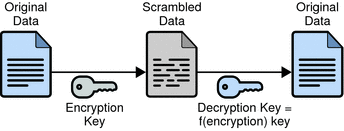
   With symmetric-key encryption, the encryption key can be calculated from the decryption key, and vice versa. With most symmetric algorithms, the same key is used for both encryption and decryption. 

The following figure shows a symmetric-key encryption.
Symmetric-Key Encryption

Figure shows symmetric-key encryption.

Implementations of symmetric-key encryption can be highly efficient, so that users do not experience any significant time delay as a result of the encryption and decryption. Symmetric-key encryption also provides a degree of authentication, since information encrypted with one symmetric key cannot be decrypted with any other symmetric key. Thus, as long as the symmetric key is kept secret by the two parties using it to encrypt communications, each party can be sure that it is communicating with the other as long as the decrypted messages continue to make sense.

   Symmetric-key encryption is effective only if the symmetric key is kept secret by the two parties involved. If anyone else discovers the key, it affects both confidentiality and authentication. A person with an unauthorized symmetric key not only can decrypt messages sent with that key, but can encrypt new messages and send them as if they came from one of the two parties who were originally using the key.

    Symmetric-key encryption plays an important role in the SSL protocol, which is widely used for authentication, tamper detection, and encryption over TCP/IP networks. SSL also uses techniques of public-key encryption, which is described in the next section.

 Asymmetric Key Encryption :


Public-Key Encryption

The most commonly used implementations of public-key encryption are based on algorithms patented by RSA Data Security. Therefore, this section describes the RSA approach to public-key encryption.

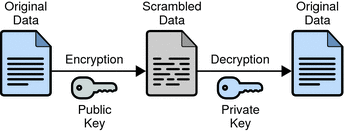
   Public-key encryption (also called asymmetric encryption) involves a pair of keys—a public key and a private key—associated with an entity that needs to authenticate its identity electronically or to sign or encrypt data. Each public key is published, and the corresponding private key is kept secret. 

The following figure shows a simplified view of the way public-key encryption works.
Public-Key Encryption


Figure shows public-key encryption


    Public—key encryption lets you distribute a public key, and only you can read data encrypted by this key. In general, to send encrypted data to someone, you encrypt the data with that person’s public key, and the person receiving the encrypted data decrypts it with the corresponding private key.

   Compared with symmetric-key encryption, public-key encryption requires more computation and is therefore not always appropriate for large amounts of data. However, it’s possible to use public-key encryption to send a symmetric key, which can then be used to encrypt additional data. This is the approach used by the SSL protocol.

     As it happens, the reverse of the scheme shown in Figure also works: data encrypted with your private key can be decrypted with your public key only. This would not be a desirable way to encrypt sensitive data, however, because it means that anyone with your public key, which is by definition published, could decrypt the data. Nevertheless, private-key encryption is useful, because it means you can use your private key to sign data with your digital signature—an important requirement for electronic commerce and other commercial applications of cryptography. Client software can then use your public key to confirm that the message was signed with your private key and that it hasn’t been tampered with since being signed. Digital Signatures on Digital Signatures and subsequent sections describe how this confirmation process works.


========================
Video Lectures


Symmetric Key Cryptography : part 1


Symmetric Key Cryptography : part 2


Symmetric Key Cryptography : Block Ciphers & DES


Block Ciphers, DES, Triple DES


Integrity & message Authentication


Symmetric & Asymmetric Encryption


Asymmetric Encryption

============================================