GENERAL PACKET RADIO SERVICE (GPRS)
The standard bandwidth of 9.6kbps available for the data services is not sufficient for the requirements of today’s computers .To enhance the data transmission capabilities of GSM , two basic approaches were developed…….

1.High speed circuit switched data(HSCSD):---------
The first one is high speed circuit switched data . It allocates several TDMA slots within a TDMA frame .This allocation can be asymmetrical ,i.e., more slots can be allocated on the downlink than on the uplink ,which fits the typical user behavior of downloading more data .One problem of this configuration is that the MS is required to send and receive at the same time .It also has some disadvantages as it uses the connection oriented mechanisms of GSM . These are not at all efficient for computer data traffic, which is typically bursty and asymmetrical.
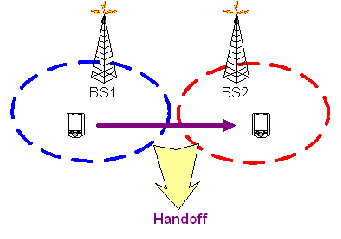
For n channels , HSCSD requires n times signaling during handover, connection set up and release . Each channel is treated separately. The probability of blocking or services degradation increase during handover , as in this case a BSC has to check resources for n channels , not just one .
2. GENERAL PACKET RADIO SERVICE (GPRS) :----------

The next step towards more flexible and powerful data transmission is GPRS .It is more efficient and cheapest because in this mode charging is based on volume not on connection time like HSCSD . The main advantage of GPRS is the ‘always on’ characteristic no connection has to be setup prior to data transfer. In GPRS time slots are not allocated in a fixed , pre determined manner but on demand .All time slots can be shared by the active users ;up-down link are allocated separately. Allocation of the slots is based on current load and operator preferences . The GPRS concept is independent of channel characteristic and of the type of channel ,and does not limit the maximum data rate.
GPRS offers a point-to-point (PTP) packet transfer service. One of the PTP version offered is the PTP connection oriented network services (PTP-CONS), which includes the ability of GPRS to maintain a virtual circuit upon change of the cell within the GSM network. The other PTP version offered is the PTP connectionless network service (PTP-CLNS) , which support applications that based on the internet protocol IP. Multicasting , called point-to-multipoint(PTM) service. Users of GPRS can specify a QoS-profile. This determine the service precedence ,reliability class and delay class of the transmission , and user data throughput. GPRS exhibit a large jitter compared to fixed networks.
The GPRS architecture introduces two new network elements , which are called GPRS support nodes(GSN) and work like router .The gateway GPRS node (GGSN) is the interworking unit between the GPRS network and packet data networks(PDN). This node contains routing information for GPRS users ,performs address conversions , and tunnels data to a user via encapsulation . The GGSN is connected to external networks to external networks via Gi interface and transfer packets to the SGSN via an IP-based GPRS backbone network. The other new element is the serving GPRS supports node(SGSN) which supports the MS via the Gb interface. Packet data is transmitted from a PDN , via the GGSN and SGSN directly to the BSS and finally to the MS . The MSC which is responsible for data transport in the traditional circuit-switched GSM, is used for signaling in the GPRS scenario. Before sending any data over the GPRS network ,an MS must attach to it ,following the procedure of the mobility management .The attachment procedure includes assign a temporal identifier ,called a temporary logical link identity (TLLI) ,and a ciphering key sequence number(CKSN) for data encryption.

GPRS ARCHITECTURE REFERENCE MODEL
The protocol architecture of the transmission for GPRS is given in the figure . All the data within the GPRS backbone ,i.e. ,between the GSNs , is transferred using the GPRS tunneling protocol(GTP) . GTP can use two different transport layer protocols , TCP or UDP. The network protocol for the GPRS backbone is IP. To adapt the different characteristics of the underlying networks , the subnetwork dependent convergence protocol(SNDCP) is used between an SGSN and the MS. A base station subsystem GPRS protocol(BSSGP) is used to convey routing and QoS-related information between the BSS and SGSN.BSSGP does not perform error connection and works on the top of a frame relay network .Finally , radio link dependent protocol are needed to transfer data over the Um interface .

GPRS TRANSMISSION PLANE PROTOCOL REFEERNCE MODEL
The radio link protocol (RLC) provides a reliable link , while the MAC control access with signaling procedure for the radio channel and mapping of LLC frames onto the GSM physical channels . Capacity can be allocated on demand and shared between circuit-switched channels and GPRS. This allocation can be done dynamically with load supervision or alternatively, capacity can be pre-allocated. The application uses TCP on top of IP , IP packets are tunneled to the GGSN, witch forwards them into PDN . All PDNs forward their packets for a GPRS user to the GGSN ,the GGSN asks the current SGSN for tunnel parameters ,and forward their packets via SGSN to the MS. All MS are assigned private IP address which are then translated into global address at GGSN using NAT. The advantage of this approach is the inherent protection of MSs from attacks. Private address are not routed through the internet so it not possible to reach an MS from the internet. This is also a disadvantage if MS wants to offer a service using a fixed , globally visible IP address.
1.High speed circuit switched data(HSCSD):---------
The first one is high speed circuit switched data . It allocates several TDMA slots within a TDMA frame .This allocation can be asymmetrical ,i.e., more slots can be allocated on the downlink than on the uplink ,which fits the typical user behavior of downloading more data .One problem of this configuration is that the MS is required to send and receive at the same time .It also has some disadvantages as it uses the connection oriented mechanisms of GSM . These are not at all efficient for computer data traffic, which is typically bursty and asymmetrical.
For n channels , HSCSD requires n times signaling during handover, connection set up and release . Each channel is treated separately. The probability of blocking or services degradation increase during handover , as in this case a BSC has to check resources for n channels , not just one .
2. GENERAL PACKET RADIO SERVICE (GPRS) :----------
The next step towards more flexible and powerful data transmission is GPRS .It is more efficient and cheapest because in this mode charging is based on volume not on connection time like HSCSD . The main advantage of GPRS is the ‘always on’ characteristic no connection has to be setup prior to data transfer. In GPRS time slots are not allocated in a fixed , pre determined manner but on demand .All time slots can be shared by the active users ;up-down link are allocated separately. Allocation of the slots is based on current load and operator preferences . The GPRS concept is independent of channel characteristic and of the type of channel ,and does not limit the maximum data rate.
GPRS offers a point-to-point (PTP) packet transfer service. One of the PTP version offered is the PTP connection oriented network services (PTP-CONS), which includes the ability of GPRS to maintain a virtual circuit upon change of the cell within the GSM network. The other PTP version offered is the PTP connectionless network service (PTP-CLNS) , which support applications that based on the internet protocol IP. Multicasting , called point-to-multipoint(PTM) service. Users of GPRS can specify a QoS-profile. This determine the service precedence ,reliability class and delay class of the transmission , and user data throughput. GPRS exhibit a large jitter compared to fixed networks.
The GPRS architecture introduces two new network elements , which are called GPRS support nodes(GSN) and work like router .The gateway GPRS node (GGSN) is the interworking unit between the GPRS network and packet data networks(PDN). This node contains routing information for GPRS users ,performs address conversions , and tunnels data to a user via encapsulation . The GGSN is connected to external networks to external networks via Gi interface and transfer packets to the SGSN via an IP-based GPRS backbone network. The other new element is the serving GPRS supports node(SGSN) which supports the MS via the Gb interface. Packet data is transmitted from a PDN , via the GGSN and SGSN directly to the BSS and finally to the MS . The MSC which is responsible for data transport in the traditional circuit-switched GSM, is used for signaling in the GPRS scenario. Before sending any data over the GPRS network ,an MS must attach to it ,following the procedure of the mobility management .The attachment procedure includes assign a temporal identifier ,called a temporary logical link identity (TLLI) ,and a ciphering key sequence number(CKSN) for data encryption.

GPRS ARCHITECTURE REFERENCE MODEL
The protocol architecture of the transmission for GPRS is given in the figure . All the data within the GPRS backbone ,i.e. ,between the GSNs , is transferred using the GPRS tunneling protocol(GTP) . GTP can use two different transport layer protocols , TCP or UDP. The network protocol for the GPRS backbone is IP. To adapt the different characteristics of the underlying networks , the subnetwork dependent convergence protocol(SNDCP) is used between an SGSN and the MS. A base station subsystem GPRS protocol(BSSGP) is used to convey routing and QoS-related information between the BSS and SGSN.BSSGP does not perform error connection and works on the top of a frame relay network .Finally , radio link dependent protocol are needed to transfer data over the Um interface .

GPRS TRANSMISSION PLANE PROTOCOL REFEERNCE MODEL
The radio link protocol (RLC) provides a reliable link , while the MAC control access with signaling procedure for the radio channel and mapping of LLC frames onto the GSM physical channels . Capacity can be allocated on demand and shared between circuit-switched channels and GPRS. This allocation can be done dynamically with load supervision or alternatively, capacity can be pre-allocated. The application uses TCP on top of IP , IP packets are tunneled to the GGSN, witch forwards them into PDN . All PDNs forward their packets for a GPRS user to the GGSN ,the GGSN asks the current SGSN for tunnel parameters ,and forward their packets via SGSN to the MS. All MS are assigned private IP address which are then translated into global address at GGSN using NAT. The advantage of this approach is the inherent protection of MSs from attacks. Private address are not routed through the internet so it not possible to reach an MS from the internet. This is also a disadvantage if MS wants to offer a service using a fixed , globally visible IP address.